The Train

The first train backed into Beaufort on November 18, 1906.
 
Prior to train service to Beaufort, visitors who came by train were met at the railroad terminus in Morehead City and brought to town by boat. After the railroad bridge was built across the channel, tracks were laid down the middle of Broad Street - bringing the outside world to Beaufort. For a short period, before the Norfolk & Southern Railway wye (turnaround) was completed, the first trains backed into Beaufort.
 
 Leaving Morehead City; Card sent by Della Dudley Eubanks


 Arriving Beaufort

One of the first trains entering Beaufort engine first.
 
In those early years, as the train lumbered into town on Broad Street, passengers would have seen sundries shops – like Noe’s, Dave Williams’ Grocery, and Richard Rice’s Fabric Shop - that sold everything from penny candy to 5-cent pickles. Until the 1920s, when the first automobiles came to town, passengers were met at the Beaufort Depot, at Broad and Pollock, and transported by horse-and-buggy to inns or family cottages.

Neal Willis wrote, "The train came in about ten a.m. and turned around at the Wye, a lot behind the present fire station, and then went to Goldsboro and returned to Beaufort in the afternoon. It left around 3 p.m. for the return trip to Goldsboro.

"There was a mail car on the train in which mail clerks could sort mail while traveling between town. There was a hook that extended from the side of the car that caught the mailbag hung near the track. This allowed mail to be picked up without the train stopping.

"Salesmen would come in on the a.m. train, call on the businesses and catch the three o'clock passage out. We also had a freight train that brought in large parcels. It had coal cars that brought coal to the ice plant known as Beaufort Ice and Coal. The ice plant sold coal and would deliver it to your house in a horse drawn wagon. During the Depression we picked up coal that dropped from the coal cars.

"In potato season, I have counted as many as one hundred freight cars loaded with potatoes being shipped from Beaufort to markets all over the country.


"The Norfolk Southern also ran excursion trains in summer that brought people from Raleigh, Kinston and Goldsboro on weekend. There were several carloads.”


Eighty-six years after the first train backed into town, the train made its last official run to Beaufort in 1992. After that, an engine with one car would often make trips into town, stopping to wait for cars temporarily straddling the track. The removal of the tracks began in the first block of Broad in 1994.


Ginny Welton, longtime resident of Broad Street has written, “it was a sad day when the tracks of the railroad were taken up from Broad Street. How many generations of pennies, nails, and even quarters were flattened as the train rolled over them…as the economy of Beaufort grew? The train had brought to 211 Broad Street some of the outside world…as logs from other countries went past…from the port at Morehead City to the Atlantic Veneer Company on the east end of Beaufort.”

Beaufort-Morehead Railroad Diesel Locomotive

1939 Post Office Murals

Crissie Wright in 1886 winter storm
Mailboat "Orville G" to Cape Lookout *
Canadian geese used as decoys
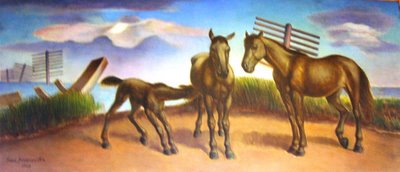
Wild sand ponies
The four murals in the old Beaufort Post Office, painted in 1939 by Simka Simkhovitch, are now a national treasure! The murals were commissioned by the United States government under Roosevelt’s New Deal Federal Arts Program, which gave work to American artists during the Depression years from 1933-1943.

(1941 photograph - Wikipedia)
The artist, Simka Simkhovitch, was born in Petrograd, Russia on May 21, 1893 and died February 25, 1949 in Milford, Connecticut. He studied at the Royal Academy in St. Petersburg and was awarded a first prize by the First Soviet Government in 1918. But by 1924 the new Russian government had become repressive and Simka fled to the United States where he became a citizen. He had his first American exhibition in New York City in 1927.

After receiving a telegram from Beaufort Postmaster Wiley Higgins Taylor, Simkhovitch accepted the offer to paint the four murals for the Beaufort Post Office. The artist spent only a few days in Beaufort and returned to his Greenwich, Connecticut studio to paint the four large oil paintings on canvas. He was paid $1900 for his work.

Simkhovitch’s description of the four murals, as noted in his 1939 letter, included:

“The main one tells a local incident that occurred over fifty years ago, of the three-masted schooner Crissy Wright. One stormy, bitterly cold day this schooner was driven on one of their shoals, with a crew of six, whom it was impossible to rescue until the storm subsided. To keep up the spirit of the two men who showed signs of life on board, bonfires were built on the shore, while the rescuers waited until they could go out to the schooner. When they got to them the next day, four members were found frozen to death, and two were brought ashore still living, but subsequently died. Today, amongst the natives of Beaufort and its vicinity, very bad weather is proverbially known as a ‘Crissy Wright day.’

"The second panel shows the Cape Lookout Lighthouse erected after this accident; and the mailboat now employed to carry necessary supplies to the keeper and crew.

"The two other panels represent local colour. One of the Canadian geese used as decoys during the duck hunting season, with a fish net drying in the background. The other, of the legendary Sir Walter Raleigh wild sand ponies, who still roam the sand dunes and marshes of Beaufort in great numbers.”

The post office closed its doors in September 2010. When the town of Beaufort purchased the building in 2011, the USPS agreed to a 25-year loan of the murals. In return, the town agreed to maintain the historical aspects of the lobby, including keeping post office boxes in place. 

Simkhovitch's works are in the permanent collections of the Dallas Museum of Art, the National Museum of American Art and the Whitney Museum of American Art.

* Mailboat "Orville G" was built by Carl Gaskill and named for his son Orville Grant Gaskill. The vessel also carried freight and passengers from "Down East" Carteret County to Beaufort. (By 1940, the Gaskill family lived at 709 Ann Street (purchased from Postmaster R.B. Wheatley.) C.G. Gaskill Company was on Front Street; it became Gaskill-Mace Hardware, and then Gaskill's Hardware, which closed its 900 Live Oak store in 2013.

1937 Beaufort, NC Post Office

     Below is the Clark-Duncan House, corner of Front and Pollock Streets, before it was moved eastward to make room for the 1937 Post Office. Built by Dr. Francis Moore Clark, the house was sold to Dr. Charles Lucas Duncan about 1910. 

     Dr. Francis Moore Clarke (1870–1918), son of Dr. Edward Clarke and Florence Mary Gibbs, was born in Middletown, Hyde County, NC. After graduating from UNC, he began his practice in Beaufort about 1893, married Eumeda Mann in 1896, and built this home about 1905; about 1910 he moved to Beaufort County and sold the house to Dr. Charles Lucas Duncan.
     Dr. Charles Lucas Duncan (1872–1937), son of Thomas Lucas Duncan and Annie Leecraft Perry, attended Trinity College and UNC Chapel Hill, where he met and married Virginia Clyde Mason (1876–1954) in 1900. They first lived at 207 Front Street and became parents of Annie Virginia, Grace Wilson and Clyde Mason Duncan. Dr. Duncan operated his medical office and Beaufort Drug Store on the NE corner of Front and Turner Streets. His dredge boat NeverRest was used to build the Beaufort-Morehead City causeway.  
_________________________________________________

      On August 31, 1933, Wiley Higgins Taylor Sr. assumed the postmastership at Beaufort. He was to retain that office for fifteen years and nine months. The US Post Office at 701-703 Front Street was built in 1937. Federal employees Louis A. Simon and Neal A. Melick were supervising architects. 
 
The 1997 Ruth Little Survey described the 1937 Post Office as, "A Colonial Revival building has brick veneer in Flemish bond, sash with concrete sills and lintels and a cupola with Doric pilasters and arched louvers. The handsome front entrance has a double-leaf door with transom and segmentally arched hood on which is mounted a golden eagle statuette. The entrance is flanked by fluted Doric pilasters. The interior features marble wainscot."
 
 
Below are photographs of the construction.
 Courtesy the US Post Office historian's office in Washington, DC.

The Clarke-Duncan house, on the right, was moved from the corner of Front and Pollock 
to make room for the new Post Office.

On the left is the Old Inlet Inn to the west in the 600 block of Front Street - now the site of BB&T. Note the old water tower in the background.

West corner of Front and Pollock Streets showing the west side of the building. 
The south front side of the building faces Front Street on Taylor's Creek.

 
The interior features FOUR MURALS painted in 1940 by Russian artist Simka Simkhovitch; under Roosevelt's New Deal Arts Program, artists were given work during the Depression.  

The Mail


This April 24, 1813 letter, to Beaufort from the Postmaster General in Washington, DC, gave permission to contract mail service once a week. - National Archives -

Post Office Department records indicate that the Beaufort Post Office was established October 2, 1797, with David Hall as the first Postmaster. In 1800 Brian Hellen was the second Postmaster, followed by Thomas Cooke in July 1813 and Bridges Arendell in 1814.

The records indicate that from 1797 through 1833 service to the Beaufort office was by horseback. It began to be served by two-horse coaches in 1834 and by sulkies in 1847. The route was from New Bern, by Beaufort and Swansboro. The service continued from New Bern through 1855.

Service was once every two weeks in 1805, but increased to once a week about 1814. About 1855 the Beaufort office, at the corner of Ann and Turner Streets, received mail by stage coach three times a week.

On October 3, 1853 Jesse H. Davis performed the first water service, once a week, on route No. 3000 from Beaufort to Smyrna in an open sail boat.

Compensation to the postmaster was $47.08 for the fiscal year 1825. By 1830 it was $296.46 and by 1911 annual compensation increased to $1600.

Domestic money order business was established at Beaufort on July 6, 1874. Rural delivery service was established in 1903 with one carrier at $600 per annum. City delivery began in 1926.


Sterling Price Hancock


Sterling Price Hancock 
Below is an article written by Laura Duncan Davis Piner, included in the 1982 Heritage of Carteret County, Vol. I. - From The Coaster Morehead City, Nov. 23, 1904, Editor: R.T. Wade. (Laura Duncan Davis was the daughter of Mattie King Hancock Davis and Ernest J. Davis, thus making her the granddaughter of Sterling Price Hancock and Sallie Gertrude Davis.)

“It being rumored last night that S.P. Hancock would, without force of arms and malice aforethought felonious take and carry away from her home Miss Sallie Gertrude Davis, contrary to the wishes of her many admirers, and against the peace and dignity of love-lorn gallants, this editor went over to Beaufort to be an accomplice of the gallant sheriff.

Long before the appointed hour friends of both parties came laden with presents and by 9 o’clock, standing room in the large hallway and porch at 301 Ann St. was taken up.

One corner of the parlor was made into a bower of chrysanthemums and under a floral horseshoe stood Sterling P. Hancock and Sallie Gertrude Davis, while the Rev. T.P. Noe made them man and wife. Sterling by name has proven his sterling qualities that our people admire, as is attested by his continuance in office as sheriff of Carteret County.

On one side of the floor was piled up and displayed on tables about 200 presents. It looked like opening day in a jewelry store, and these tributes from friends made glad the hearts of Sterling and his bonnie bride.

The bride is the daughter of Mrs. James Chadwick Davis of Beaufort. She was daintily attired in white silk and allover lace. Her pretty cheeks aglow from new sensations awakened with seductive smiles, animated with the newborn joy, she was a picture worthy the winning of any man, and well may he feel proud of his prize.

That we wish them all the joy attainable goes without saying, and long may they live to demonstrate to the world that marriage is not a failure.”

Sterling Price Hancock, son of  Martha G. Ward and Robert Hancock, was born on November 7, 1861, just outside of Beaufort in the Ward-Hancock house, then located in Simpson Field.

The office of Sheriff of Carteret County was held by S.P. Hancock for about 20 years until the Republican landslide of 1916, which removed the Democrats from office. During this period the duties of the sheriff included the responsibilities of being county tax collector. Sheriff Hancock also was a successful merchant and farmer all through these years. In 1893, he opened a grocery business at 421 Front Street; the letter head is repeated below.

HANCOCK & COMPANY
Staple and Fancy Groceries
Fresh and Salt Meats a Specialty
Fruits...Grain and Hay...Wire Fencing

Sheriff Hancock also ran a wholesale and feed business in Davis Hall, on the south side of Front Street. The location on Taylor’s Creek made his varied merchandise easily accessible to the boat trade. After World War, George W. Huntley married Mrs. Hancock’s sister, Miss Minnie Davis, the businesses merged into the Hancock-Huntley Co. with offices and store on the corner block of Live Oak St. and the Lennoxville Road.

Behind the original store was a livery stable where horses, wagons and mules were tended for personal use as well as rental and sale. A small white mule named “Little Jenny” is still remembered by Garfield “Blue” Suggs and Lucian Johnson, who worked for Mr. Hancock for years. He had a great love of horses, and bred and sold Banker ponies, with sometimes as many as 75 to 100 on his land Down East. He owned also a special black stallion named “King Mont” who won many races throughout the county and state. It is told that “King Mont” broke his previous speed record when returning to town transporting a large black bear that Sheriff Hancock had killed at Back Creek. During this period the popular style of horse racing was with the two-wheel surrey or cart. One of the special events in Beaufort on the 4th of July and other holidays was the trotting race down Ann Street from the oyster factory on the west end. 
 
Although horses were his first love, Sterling Hancock was a man of progress. He and Dr. C.S. Maxwell owned cars in this county long before others. The Sheriff bought two blue Mitchells – one to drive and the other to provide ready parts as any repairs were needed.

It is reliably reported that Sheriff Hancock had a deed for Bogue Banks property (now Atlantic Beach and environs) written as “nine miles from sea to sound.” The land was sold to the Royal and Hoffman-Roosevelt families, but he continued to be involved and interested in the area. He often hunted on the Hoffman estate and stayed at the “tea house” on the ocean side. This site was renowned for the lovely rose gardens amidst the sand. Alice Hoffman often consulted Sterling Hancock concerning the development of her livestock and property on the banks.

It was through Mrs. Hoffman also that he obtained the Perkins Place on North River near the present Oak Acres development. The house was built by Caroline Perkins – both she and Alice Hoffman had come to this area from Rochester, N.Y. – and was locally known as “The Mansion” because of its size and spaciousness and the fact that it was the first in the county with Delco electric light and central heating, all designed and furnished by a New York architect. Mr. Hancock acquired the property from the Perkins estate following her death and lived there for several years. The house burned in the early 1930s.

Sterling Hancock died November 7, 1926, on his 65th birthday. Though there is little record of any formal education, he was an insatiable reader and widely respected for his intellect and literary knowledge. Poetry was a great favorite and he liked to recite Sir Walter Scott’s “The Lady of the Lake.” He also excelled in county boxing matches, without gloves, until the years the younger men took over. A gentleman of many talents, interests and abilities, he was loved and respected by people in all facets of county and state life.

Sources: recollections and records of family and friends, old newspaper articles, as well as his business and personal correspondence. - Laura Duncan Davis Piner 
______________________________

LAURA DUNCAN DAVIS PINER, 1931-2002, was a valued artist and teacher. She was instrumental in converting an early Beaufort house into a gallery named after her mother Mattie King Hancock Davis – now on the Beaufort Restoration Grounds and managed by the Beaufort Historical Association.

Early Fire Department

 The Beaufort News – May 6, 1943 

The Beaufort Fire Department will celebrate its 36th birthday on May 10th. A number of the present-day firemen were not even born in 1907 when it was organized as the Robert E. Lee Fire Department, yet 12 of the original members are today honorary members of the present company: Walter Longest, Jesse Fulcher, Hugh Jones, Charlie Hatsell, George Brooks, “Lon” Gardner, Wiley Taylor, I.N. Moore, Dave Jones, Seth Gibbs, Herman Howland, and Hugh Longest.

Members who have since died or moved away were: Frank Longest (the first chief), “B” Robinson, John Skarren, Jack Gibble, Will Skarren, Harvey Ramsey, Dan Fowle, Rudolph Dowdy, Frank Skarren, Jim Fuller, Henry Marshall, Charles Skarren, Theo Adair, and Jack Mades.

The Beaufort Fire Department came into being before we had the present Town Hall in the west end of which the Fire Company is comfortably housed today. In those days, the Town Hall was in Winfield Chadwick’s building on the east side of Craven Street—the “lockup” below and town offices above, and across the street on the Howland property was the frame building that housed the fire engine.

When a fire broke out, everybody ran about frantically yelling “Fire!” Then to further spread the alarm, the school bell and church bells rang.

A few days before the new company was 11 months old, the call of “Fire!” at three o’clock in the morning brought the company to what the old Lookout described as “the most horrible fire in Beaufort’s history"—the Roberson house on the northwest corner of Ann and Turner street in which Miss Henrietta Roberson was burned to death.

Quoting further from the old Lookout, “The Robert E. Lee Fire Company and the Colored Fire Department arrived on the scene in short order. The new fire engine was connected to the fire plug on the corner, but as the water did not come promptly, the engine was taken to the waterfront at the end of Turner Street, and the hose thrown overboard.”

April 1908 Ruins of the Roberson home - 315 Ann Street 

Robert E. Lee Fire Company
Photo courtesy Beaufort Fire Department

___________________
 In the foreground are the following members of the 1943 company, 
eight of whom are honorary members of the fire company: 
Frank Longest, Walter Longest, “B” Robinson, John Skarren, Jake Gibble, Will Skarren, Jesse Fulcher, Charles Hatsell, George Brooks, “Lon” Gardner, Harvey Ramsey, Dan Fowle, Wiley Taylor, I.N. Moore, Rudolph Dowdy, Frank Skarren, Jim Fuller, Henry Marshall, Theo Adair, and Dave Jones.
______________________________
Editorial comment in the same paper: “Before this town had a fire engine, it had a bucket brigade which rendered efficient and valiant service. Since the purchase of the engine, the brigade has been discontinued. Result: The spectators, who arrive at the scene of a conflagration before the engine, stand idly around waiting for it to come. If the brigade was reorganized, in many cases the fire could be extinguished during the brief space of time thus lost.” 

The bucket brigade, the passing of which the editor of the Lookout was regretting, was the first fire department. It required but equipment of buckets and ladders, and men enough to keep an endless chain of buckets of water pouring on a fire. There was a chief, but no roster of members—every man in town was expected to show up and do his part.

This was followed by the famous hand pumping engine, the salesman’s dramatic demonstration of which was one of the highlights of late 19th century Beaufort days. The salesman took a little house just east of the monument at the corner of Front and Pollock, filled it with trash, set it afire, let it get underway, then showed the efficiency of the engine, so successfully that it was sold on the spot. 

To operate, the engine was taken to the dock, the intake dropped in the water, and ten or fifteen men would get on each side and pump for all they were worth.

The first gasoline engine worked the same way, but the intake was used either in the water or attached to “wells” established at ten or twelve points about town, several of which are said to be still in existence, although dry. This engine was also pulled by the men who, as Mr. Charles Hatsell says, were pretty well winded and worn out by the time they got to the fire, and in poor condition to do effective fighting.

The following year, a big black horse, “Dick,” was bought to pull the town dray and to act as fire horse. Dick was alright for the dray, but the engine was heavy and the old street sandy, and he resented his role as fire horse. Sam Pigott had him in his charge. As soon as an alarm was given, he was supposed to unhitch him from the dray, take him to the fire house, hitch him with speed to the engine and tear to the fire, but Dick is said to have been as apt to go in reverse as forward, and Seth Gibbs was the only one who could beat him into action. He would get up on the seat with Sam and beat while Sam held the reins. Finally Mr. Gibbs became to completely master--to get up on the seat and yell at Dick was all that was necessary.

According to old timers, the biggest fire [1888] the town ever had dates back well before the present fire company. It was when the south side of Front Street burned from what is now Penders, the Jones building, to the present Standard Oil Station. That was when the old market stood at the end of Turner between the present-day Standard and Gulf stations. 

The fire is said to have been almost under control at the wood yard, two doors from Dill’s on the corner, but there was some confusion and it got out of control again, burned to the corner and the market had to be torn down to save the Davis Building on the west side of Front and Turner. 

Moore’s Grocery store and all between there and Dill’s was burned. Mr. Hugh Jones tells of the string of men from the water to the tops of the buildings handing up buckets of water. As they were emptied, the men threw them back in the water, where they were picked up by men stationed there, refilled, and handed back up, keeping the string of buckets continuous. So hot was it, that the men say the money in their pockets turned black. 

It was at this fire that groceries and drygoods were taken across the street and piled behind the stores for safety; these piles are said to have disappeared almost as fast as they were deposited, so that people round about who had never boasted a new suit or pair of shoes before in their lives were, for a long time, explaining their new clothes.

Other outstanding fires in memories of charter members of the present company are the Sanders General Merchandise Store on the south side of Front Street, and one Mr. Charles Hatsell described as the most frightening of his experience when fire broke out in the colored church and school house opposite the jail one night when a north wind was blowing so hard that it took burning shingles half way to the Fort and caught the roof of the old hotel, the building where Mr. Avery now lives.

The summer [unreadable] fire, the Town Commissions authorized “a house ten feet wide by 20 feet long on the lot at the Town Hall for the small fire engine.” In October of that year, Seth Gibbs was made Fire Chief and H.C. Jones, Assistant Chief, and the plan was announced to “organize a fire company or reorganize the old one.” At the first meeting of the board, following his appointment, Mr. Gibbs made the following report on the company:

    “I beg to report the conditions of the fire department of the town as follows. As chief of the fire department, I have inspected and inquired into the apparatus and find it with few exceptions in good condition. Many of the wells have been tested and all so far have been satisfactory save the one on the corner of Ann and Turner Streets. I am told by the engineer this does not supply as good a stream as others or as it should.
    “A call was made since the last meeting of the board for the reorganization of the fire company, a meeting held and a company organized with Mr. W.S. Robinson as foreman. I have requested the Colored Fire Department to take out the hand engine for trial and pumps, these have, not up to the present, responded owing to the rainy weather at each appointed time.
    “I find that the nipples for the nozzles are not as good as should be, being an inferior kind. I recommend that the nozzles be fitted with a standard nipple that could be more effective in case of stubborn fire.
    “I recommend further that there be at once a grade made at the foot of Orange Street at the bulkhead, so that the fire engine could get to the water without danger to said engine being damaged; this is very necessary for the protection of that portion of the town along Orange between Ann and Front.
    “It appears very important that some arrangements should be made for keeping of the horse nearer the fire engine and that said fire engine be fitted with shafts that would enable use of the horse to it.”


The horse, as the time, was kept down on Craven Street and had to be taken up to the Town Hall to the engine. The constable was ordered to fix a wooden bridge at the south end of Orange Street at once so the engine could be quickly carried to the waterfront.

In February 1909, the Fire House had its first bell  “sufficient to sound alarm so that it could be heard in the various parts of town,” and for the first time “oil cloth coats” were provided to protect firemen from the water.  

The Beaufort Company has come a far way since the first decade of the century. Julius Duncan, who resigned as chief last July, reports the following equipment, all of which is, of course, motorized: the first motorized pumper bought in 1924, a 1000 gallon pumper bought in 1928, a 500 gallon pumper bought in 1936, and an aerial truck (hook and ladder) in service since 1941. The latter was built by members of our fire company. It is most modern in design, has the first set of aluminum ladders used in North Carolina, and makes Beaufort the smallest town in the state to boast an aerial truck—Greenville with 15,000 people is the next smallest with one.

Since 1926, we have had a thoroughly automatic fire alarm system with ten signal boxes located about town

Following the Town Hall fire of December 1928, when the west end of the building was damaged so that it had to be practically rebuilt, the department has been housed in the present up-to-date home. 

Today’s members carrying on the tradition of the old company are: H.H. Lewis Jr., chief; John Hill, secretary and treasurer; W.C. Oglesby, 1st foreman; B.H. Whitehurst, 2nd foreman; J.C. Pake; Dalton G. Eubanks, E.M. Noe, T.R. Whitehurst, Gray Hassell, J.E. Arrington, C.J. Brinson, C.W. Britton, D.P. Clawson, J.M. Darling, C.S. Harrell, C.G. Holland, B.L. Jones, J.A. Lewis, W.B. Longest Jr., R.E. Mades, C.D. Manson, C.M. Noe, R.T. Norris, West H. Taylor, B.H. Noe, W.E. Lewis, Leaman Eubanks, William D. Skarren, W.J. Moore Jr., O.L. Caughman, H.C. Bunch, Hubert Fodrie, W.D. Guthrie, and Raymond Springle.

Julius Fletcher Duncan, elected Fire Chief, January 1940, resigned August 1942, made more improvements in the department for the length of his service than any chief of the department ever had. 

The fine aerial truck (hook and ladder) was constructed under his leadership.

[Julius Fletcher Duncan (1914-1958) died December 12, 1958, on the front porch of his home, the Duncan House, after helping battle a large Front Street fire.]
_______________________________________________________________
 

Beaufort, Carteret County December 1913
One chief, two companies. Two stations.

First company (white) next to 406 Craven Street: 20 volunteers. One paid driver. One partly paid engineer. One horse with drop harness, used on street work during day. One Howe triplex gasoline engine. One hose cart with 800-feet 2 1/2-inch hose. 1,000-feet 2 1/2-inch hose in reserve.  
Second Company (colored) next to Town Hall on Broad Street: 20 volunteers. One hose reel with 800-feet 2 1/2-inch hose. One hand engine. Fire alarm by whistle. Population 3,200.
________________________________________________________________

1933 Beaufort Fire Department on Broad Street
(The building was the former 1885 Beaufort High School,
moved from Courthouse Square, and use as Beaufort Town Hall.)