In April 1775, the government of Great Britain severed all trade with the newly forming American government. One of the greatest concerns, especially in North Carolina, was the consequent shortage of salt, a vital commodity for the colony. In 1775 and 1776, the Provincial Congress of North Carolina worked quickly to create salt works. The first of the works was established near Beaufort.
Salt was essential in the daily lives of Americans. It was needed as a preservative for food, with salted and dried meats being a staple for most during the winter months. In addition, Americans used salt in caring for livestock, curing animal hides, and providing for basic nutritional needs. Because of its importance, the government acted quickly.
The Provincial Congress in 1775 passed three laws related to salt and to maintain its trade. First, the body established ceiling prices on salt, to ensure that salt remained available despite shortages. Then they began rationing the already existing salt supply. Finally, the government offered a bounty prize of 750 pounds to the first person to create a salt works and manufacture salt in North Carolina.
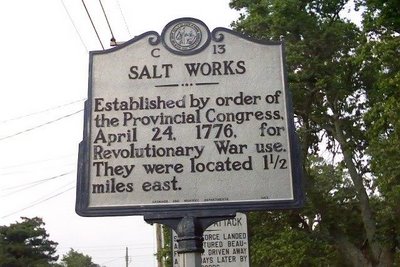
In April 1776, the Provincial Congress expanded its actions, appointing four men to act as commissioners for salt industry development. Two of the men, Robert Williams and Richard Blackledge, began to develop salt works plants soon after their appointment, drawing upon the state funds.
Turner Street marker was cast in 1939.
_________________________________________________________________________
This account focuses on Robert Williams involvement in the first Salt Works.
In his 1921 book, The Williams History, Milton Franklin Williams wrote of his great-grandfather: "Robert Williams was born in Ruthin, North Wales, April 29, 1723. He was of a roaming disposition, and went to England, from whence he is said to have sailed in his own ship for the Carolinas. Extracts from court records show that he bought land in 1765 in different parcels amounting to over 300 acres along the north side of Newport River, and on both sides of Black Creek [now Mill Creek]."
From 1765 to 1777, Williams also owned 75 acres along Taylor's Creek, including the "White House" and "Taylor's Old Field."
Though eventually unsuccessful, he was the first in North Carolina to build salt works, one east of the White House property, and another at Gallant's Point.
In "Carteret County during the Revolution," Jean Kell wrote: "Robert Williams, a planter and merchant in Carteret County, was familiar with the process of obtaining salt from seawater. …he constructed a salt works on 10 acres of land, part of which is now the Davis property toward the east end of Front Street." (See end of post.)
______________________________________________________________________
From Colonial & State Records of North Carolina
May 19, 1776 Letter from Robert Williams to James Coor
Dunant, Carteret County
Esteemed Friend:
By Captain Ward I received a copy of a minutes made by the Congress appointing me a fourth commissioner for carrying on of salt works, and as I remember he told me it was of thy promising, I am glad thou has the interest of the country so much at heart.
Depending upon it, I will exert myself, as the preservation of the province depends upon it as much as upon arms and warlike stores, and must be entered upon immediately. I shall not wait for Blackledge nor Avery. I hope my exertion will prove to general advantage and will meet the aprobation of the public. We shall take the advice of every man worthy of consulting. Wish Blackledge and Avery were here, but will delay no time, as the season will not admit of dallying and doing of business after the usual Carolina fashion. I am going to-morrow about making handbarrows, but it will not avail to set up such works without they are defended, nor can they be defended except every man is confined in his own home, and that speedily, be the works set up where they may. Do mind what I say. We know not all our friends, or at least cannot depend upon every one that pretends to be so. There have been private emissaries at Halifax, and the accursed thing has been in our camp. I am sure of it. I do not want to be tedious, nor have but little time to enlarge, but let me beg myself and others who may be in authority immediately, to keep at home all persons not employed in the public cause, and that neither strangers nor neighbors be suffered to pass without permission. A message ought immediately be sent to caution them appointed at Onslow not to trust or suffer any man to pass. Neither hair-dressers nor fiddlers nor think they are safe to confide in any man, altho’ he may bring his moulded bread and clouted shoes. I am sure I am right, and that my advice ought to be put into immediate execution. Do procure all the spades in town, and if possible all or part made use of at your post.
I am thy affectionate and assured friend,
Robert Williams
______________________________________________________________________
Letter from Robert Williams to the North Carolina Provincial Council
To Cornelius Harnet, President, and the rest of Council for North Carolina at Wilmington.
New Bern, May 27th, 1776
I have viewed with serious attention the situation of this province for a great while, and considered what it must suffer this winter, without a quantity of salt can be made with the utmost expedition, and abundance of men employed and making salt marshes, and the manner of France, Portugal and Spain. The season will be over in August. I have been long in possession of Browning upon Salt, and have made it my study for many years, and have made it my business in Portugal to go and view their salt marshes in Lisbon. I was going to Halifax some time since to propose it to the Congress there, but our William Thompson told me that Avery and Blackledge were appointed , and only £600 allowed to carry on the work, but did not tell me he was one of the commissioners himself; nor after my appointment would he consult me or say a word about it, and was unwilling to sign along with me a letter I was going to send, and since delivered myself to James Coor, which letter I also showed to our other delegate, Solomon Shepard, who also took no notice of it, and seemed quite unconcerned. Must leave others to judge from whence backwardness proceeds. When I found I was appointed a fourth commissioner, considering the common consequence, the need of dispatch, the season advancing, and our suitable situation, I was in my own mind so sure of the propriety, thinking Thompson would join and encourage, that I had engaged men to make wheels and hand-barrows. Was going to raft a large quantity of fine timber John Raston had ready, and was willing to risk the pay; was going to risk a considerable quantity of plank I had myself, set smiths to work and procure spades and hoes to make a rough shed to cook and eat under, some places under locks to keep utensils and provisions when we get them.
The salt may be preserved in conical heaps, as I have seen that done in Portugal, until it is carried away, and it will not receive any injury from the weather, although exposed to the open air for three years.
One mask or marsh must be finished first, and will, including the banks, be about 240 feet long and 150 feet large; then finish another as fast as possible, etc., and continue at it as long as the season promises any advantage from additional works. Must refer to some other observations in the draught of the letter delivered James Coor.
If the Council think well to employ me and make me the acting superintendent upon pay, and allow the whole county of 4d per bushel to myself, delivering all accounts upon affirmation, appoint paymasters to deliver money as materials are procured and work faithfully done, they may depend on the vigorous and steady exertion of my faculties; will give up my time for the purpose. Have hitherto fatigued myself, spent money and time, traveled upon occasion above 140 miles at different time already, without any view of superior advantage above the rest of the commissioners; but, as some pull back and others do not appear, I will not be pack-horse for others to share the profits.
I cannot tell, nor anybody else form a right judgment how long we shall be in getting the materials and making the first division or marsh of 18 salt beds, but would be in hopes that after we got in the way we would make another every succeeding week.
We have reason to expect that every salt marsh of 18 salt beds will make between 25 and 40 bushels a day in hot, dry weather.
All workmen to be employed as cheap as possible. Would suppose the daily expenses may be guessed at nearly thus, including provisions, which, however, must be provided separate:
8 best workmen, at 9s 8d
8 inferior ones, at 5s 4d
30 laborers, at 3s 8d
Superintendent £12
For 60 days, makes £735
Sundry materials, suppose £340
Total £1075
I wish that and much more might be laid out for the public good, and that more laborers might be employed with propriety, as every day now is of the utmost consequence. Many marshes ought to be now finished, and more carrying on.
If there is no salt made, it will require but little force to subdue and starve the province, which next spring must and will fall course, and tumble down of itself, like an old house in calm.
If what I have offered is worthy of Acceptance in receiving orders, I shall be ready at an hour’s warning, and some money must be lodged immediately in a safe hand that may be confided in New Bern.
Would recommend John Easton, an honest man, to provide provisions and to be pay master at Core Sound.
If the formality of bonds from them be thought requisite ‘tis best not to retard the work but do that part Soon as may be after ‘tis going on.
I am with due regard the Councils assured & affectionate friend,
Robert Williams
Quere: Is one company of Soldiers sufficient to guard old Topsail Inlet, the Town of Beaufort and the Salt Works?
May not General Clinton after securing his Landing at Cape Fear, send a number of men in Transports to Core Sound in 24 hours, destroy the town of Beaufort and the Salt Works, then march up and secure New Bern and without opposition secure the Numerous herds of Cattle on the Sea Coast while all the provincial Troops are kept at bay and doing or nothing at Cape Fear?
As it is evident to me and may be proved to a demonstration that people are going continually about as Spies on idle pretences, carrying intelligence much faster that our continental post. Ought not the imperious busy body be removed and all others not employed by the public, be ordered to stay at home and mind their corn fields, and none be allowed to depart from any place under any specious pretence whatsoever?
______________________________________________________________________
Friday, June 7, 1776
 |
| 1857 Map showing Gallant's Point |
Minutes of the North Carolina Council of Safety; held in Wilmington
Resolved, That the Treasurers or either of them place the Hands of Mr. John Easton of Carteret County, for the immediate use of carrying on a Salt Work in the said County, the sum of five hundred pounds to be paid to Mr. Robert Williams occasionally, for the purpose aforesaid, and that they be allowed the same in their Accounts with the Public.
Mr. Arthur Mabson appeared in Council and agreed to sell them for the use of the public, l a certain Tract of Land in Carteret County, near Beaufort, containing ___Acres commonly called Gallant’s Point, which place is judged convenient for making Salt; the value to be ascertained by two persons, one to be chosen by Mr. Mabson, the other by the Council, which being agree to, Mr. Richard Cogdell of New Bern, and Mr. Solomon Shepard of Carteret County were appointed to value the said Land.
______________________________________________________________________
July 25, 1776
From: Minutes of Council of Safety; held in Wilmington
In order to encourage the importation of Common Salt an article essentially necessary and greatly wanted in the Colony.
Resolved, That all know Friends to the American Independency will on application to the Board be permitted to export any kind of staves or heading, first entering into bond with sufficient security to import in return Salt, Arms, Ammunition and other Warlike Stores to the full amount of the net proceeds of such staves and heading.
Whereas it is absolutely necessary to prevent as far as possible all kinds of forestalling and imposition on the inhabitants of this Colony in the article of Common Salt.
Resolved, That for the future no retailer of Salt shall be permitted to receive more than twenty per cent on the prime cost for any Salt purchased in the Colony, and the Committees of the respective Counties and Towns, see that this Resolve be strictly observed, and send under guard to the Board every person who shall presume to take or receive a greater advance than is hereby allowed and permitted for Salt purchased in this Colony as aforesaid.
_____________________________________________________________________
Letter from Robert Williams to the NC Council of Safety
Beaufort, Carteret County, June the 20th, 1776
Respected Friends:
The 16th instant I found a few lines from James Coor, dated 7th of June, left in a public house in Beaufort. I expected a matter of so much importance would have been forwarded with more expedition and care. John Easton received the letter to him the day before, and sent Express immediately to my house 20 miles, that’s the Distance. But he knew not there was any letter for me, and wondered to receive orders or intimation at second hand, however went to Beaufort the day following; and went home the same evening, dissatisfied with the laconic contents of my friend Coor’s epistle, giving account indeed of my letter being laid before you, and that £500 was ordered for the present into John Easton’s hands to carry on Salt Works. But ‘tis not so Expressive as I could wish, as I know not upon what terms I am going to neglect my own Business which is not trifling, to begin great works when the Season is far advanced, and but every requisite wanting in a place they are very difficult to procure.
The resolves of the Congress I had before, and I do not consider myself as acting that Capacity but as director & Superintendant at 16 shillings per diem works are carried on and the Overlooking of the people necessary. I am glad you propose John Easton as Commissioner, as he will be of great service and necessary assistance to me; has exerted himself a great deal already, but I will never agree that any other man shall share in the bounty or keep more Cats than Catches mice.
I brought my Circumferentor and Chain down and with John Easton and others, went and laid off ten acres and 40 ps. On Gallant’s Neck, viz: 82 Po. On front and 20 poles back. There is good clay there but does not go so deep as I could wish. However, what we may want in depth I will add in Surface of my reservoir parts, and it will exale the faster. I have sent people off for Easton’s Tun Timber, advertised for spades and have some promised. Have engaged men to make wheel barrows & raft down plank. Have ordered nails to be made. Easton is now sending off to New Bern for Pork, &c. Every thing that is possible shall be done. But if I was much younger and had a back of steel, the Season is too far advanced to do great matters. Would have declined it altogether, but as I had offered my services, was afraid the public would have blamed me for not using my endeavours. I have already travelled 200 miles, on the occasion. Neglected my own business of rice planting, to my evident prejudice of about £80. Perhaps you will blame me for such strong inclination of being of public service; as in general Charity begins at home.
I am with due regard your assured friend,
Robert Williams
_______________________________________________________________________
Letter from Richard Blackledge to the NC Council of Safety
Core Sound, August ye 1st, 1776
Gentlemen:
I have been here some days past and have been trying the water at 5 different places while the people were a getting things in order, to carry on the works, but find as farr as I have been able to judge, the channel water the best both for clearness and stringht we can git. Near one peck of salt out of 32 gall. of water will be got, in this unstedey way of boiling in small pots, and the open aire.
I send per Capt. John Jones a small sample of the salt, made both from the Channell, and the flats, though its not near cured as yet. I have purchased one large Iron Kittle of Ms Wasley at £6 & have sent per Capt. Jones to Bath to try to bring three or 4 more for feare ye plates should not come. I am told the Marylenders are making in Large cast flat Iron Kittles. In case the plates should arrive, I have spoek to some workmen who saith thay can Rivett them for me. As the Seasons farr advanced I think Boyling will bee our greatest dependency for this season, but I mean to make one or 2 setts of works with which I hope we shall make some quanitty of salt by Evaperation but the place whare Mr Williams at work on I dont like, as I am certain I can erect a sett of works much cheaper & more Exstensive & deal better foundation about three miles higher up ye River, and from Experance the water equally as good & more out of the way of an enemy, and the land can be had on such termes that wont be disagreeable, to the publick. I believe, however I am this day to Treat as to the price of it.
I shall want some oxen, say 2 yoak, a cart and Timber wheels, a Boat & Cannon, which I mean to try to buy, as oxen at 5 per day will soon run away with the price of a yoak or two & we shall allways be in want of some. As the properest ways & means to make salt to advantage is of the utmost consequence to the provance, I have prevailed on Capt. Jones to waite on your honours, to ffer himself to go to Vergenia, the the salt works there & vew them, & git the best derections that is to be had, also to offer his services to you Honours as an assistance to me to carrey on the works. M Williams hath finished one of his sett of works, & is gon a considerable way on with the second, though much aganst Capt Easten or my inclination. He expected to make salt next week.
I ant seen the second account, but am told that the £500 you long sence, lent Capt. Easten advanced, as well finished the second works, or all must stop, as I find his plan & mine wont agree, to carry on to geather.
I am Gentlemen with Esteem your Honours most Obe. Humble Servant
Richard Blackledge
________________________________________________________________________
Letter from Robert Williams to the Council of Safety
Carteret County, August the 5th, 1776
To the Council,
Yours of the 11th Ulto I rec’d the 26th by Blackledge. I have finished my first Works and let on Water last Thursday the 3d instant. Expect to make Salt in 4 or 5 Days; if we have good weather I have no doubt of Success; I thought the Exigencies of the province called for a quantity rather than a Sample, however must and will in some measures submit to your orders. Let the Public I have been so anxious about suffer what they may be leaving off the works, but hope to finish a Second Division (or work) in about a week. If I by Doing transgress your orders must pay what I lay out amiss. Have discharged most of the people at high wages which was necessary, as I have no money for them at present; and my common labourers I have reduced to about 30, & as it appears you have no great confidence in my integrity, or are Diffident of my Abilities, I shall be always Willing to quit your Service, and hope to see you soon, with account quantity, and sample of the quality of Salt.
I am as usual an entire well Wisher of the good of the province
Robert Williams
_______________________________________________________________________
Letter from Robert Williams to Council of Safety
Salt Works Carteret County
August 9th, 1776
In my last I acquaintd you how & when I laid water on the first Salt works. Diderick Gibble is now scraping up of a little Salt that is made on such parts of the beds as became bare. The water was laid on the whole of the works from the river, but now Brine Pits and Salt pits are Greatly Saturated, to be ushered on the Salt beds Gently this Evening. Please observe the first water was in its Natural State, the earth Plank and Timber imbibing the best particles, so that I would not have attempted to keep the water down but for Sample Sake and in hopes to satisfie the impatience of the Public. In hopes yourselves and them will receive more agreeable accts as soon as time and season will admit. It seems as if my Second work will be finished or in great forwardness the following week. But as the people have got a report among them I am to have no more money, I am in great measure, nay altogether responsible for their wages, as the £500 is already & more expended. The weather has been unfavourable and we have had two rains since I laid on water.
I am in great haste, tho’ as usual yours,
Robert Williams
________________________________________________________________________
Letter from John Easton to Cornelius Harnett (Council of Safety)
Beaufort, ye 6th Augst, 1776
Sir,
Your Honble Board were pleased to order £500 to be deposited in my hands to be paid to Robert Williams occasionally for carrying into execution Publick Salt Works. I have now to inform you that it is expended, I could not prevail on Mr Williams to have the process fully demonstrated with that Money, have frequently told him it was the intention of the Council of Safety, but he being so confident of it himself extended his works to a second division. I am however in hopes it may still answer a public purpose, am confident Salt will make in Others, the first division has had water on the beds four days, am in hopes in 4 more salt will begin to make, after which should it continue dry, it will make fast, the second division is going on will be completed in 15 or 16 days; the men at high wages are discharged, so that am in hopes it will be carryed on with less expence that the first. I have done every thing in my power to lengthening out the £500. I have advanced Money towards carrying on the works hopeing it may meet with your approbation as I think it may be of use to the publick as the works are so far gone on with to have it finished, it is clear to the that the place where we are fixed is equal to any in the Province for the purpose, it is well sheltered against storms and I think the works are proof against a Hurricane, as they are well executed and the water equally salt. As no provision has been made for furnishing the Independent Company’s with fire Arms, I have ventured to deliver out to Captn Ward’s Company what Guns I have purchased for the Publick and take his Rect for the delivery of them when called for, I hope the Council of Safety will favr me with a Letter informing how far they may approve of my advanceing for finishing the second division of Salt works as likewise my letting out the fire Arms as mentioned above.
I am with due regard,
Your Obedt Humble Servt
John Easton
_______________________________________________________________________
Letter from Robert Williams to the North Carolina Council of Safety
September 14, 1776
On the 5th instant as my Salt beds were promising something considerable of Salt in a day or two, there fell a heavy rain and blasted all my hopes for this fall, as before then the length of nights chilled the brine and the decreased length of Days exaled it much slower than four or five weeks before, and as the same disadvantages must increase till the next Summer have quitted the works for the present while I am getting in my much neglected crop about 30 acres of rice. The Second Division of Salt works is all leveled for my salt beds and the rest of the Ground in Great forwardness, my ground timber is all fitted and scarfed, and lies on the spot. Plank for the whole ready Jointed; It should be necessary to finish that work and lay on water this fall, that Wood and Soil my get fully saturated with saline particles against next Summer; for it takes abundance more time to season that I expected, and everybody who have been making Salt in the small way hereabout have experimented the same. One Zacha Harker informed me that in a wooden or Plank’d vat he has, he at first gathered not a quart but in Continuation of 6 or 7 weeks came to Scrape a Bushel or more at a time from water of the same quality as the first Although we begun several months too late yet by experience found out on trial, which perhaps we should not have otherwise properly investigated it may be of advantage to the public that some of their money is laid out this fall, so as to be in best order against next Summer. I still trust the works will pay for themselves in due time, if this climate will produce Salt as on the coast of France or Portugal &c., I am Certain our water is as fully impregnated with Salt as theirs or more so, but their days are longer. Perhaps their winds are more keen than the Southerly Breezes on our Coast which I observe contain a good deal of humidity until far to the westward especially when on the eastern board.
Indeed so great my Anxiety been for the preservation of the Public even before I had thots of being employ’d that I am persuaded few individuals felt so much as I did.
When last I receiv’d your letter on the Subject, would not have then engaged it being so late, but for fear the public would have blamed me for not using my endeavours, but when I set about it I went on with all the industrious rapidity in my power, overlooked the shortness of time and the other numerous difficulties I had to encounter, and my mind became animated with hopes of accomplishing something for Public Good. I had a good stock of provisions and utensils procured, built several necessary temporary houses or plank sheds; dug wells; made near 40 Wheel and hand Barrows, Got Oxen Carts and Carriages upon the Spot, Employ’d many hands until after a while, and for some time work’d from 40 to 60 or upward a day—my fatigue was great for some weeks in Directing so many hands & new matters; the weather was close & rainy & my feet almost constantly wet going to the woods where my business frequently called me. I suffer’d much in my health, my business and interest at home greatly neglected. Having thus made a large and necessary preparation such as I judge the exigency of the undertaking required, I set off upon a Double work from the 1st, but not in such manner as to retard the completion of the first Division as quickly as possible. When Blackledge first came I was just then getting and had many trees in common hew’d for the Second work and when he returned with your letter were Chiefly laid in their Places and the first work or Division Just finished. Believe had you seen my Situation your Selves you would have thot mos Eligible to go on as I did, though confess the works cost far more labour & time and the ground proved more Disadvantageous than I expected, having had many roots upon Top and much dirt to move away.
I judge upon pretty near calculation, we have not expended above £160 upon the Second Division in wages since the first was finished. Believe about £70 more will compleat the 2d part in a manner much more effectual and promising success. Nothing points out to improvements and shews Defects like an Essay or a work finished. Generally every first undertaking will be defective in pt.
I herewith send my Accounts nearly as they now stand. Many people are in want and several importunate with me for the Balance of their wages. I am certainly greatly distressed my self having advanced all the money I had among them, so that I have not the wherewithal to carry on my rice harvest nor to purchase such domestic necessaries as times will afford. I must request you will order the Present ballance due to the works about £288 with or without the addition of the £70 above mentioned towards compleating what is on the verge of being finished.
I would have waited on you myself but cannot for some weeks leave home and my long neglected business.Who am your Friend,
Robert Williams
P.S. Had no hands on the highest wages since I finished the first beds, only tow I had lately to get the 2d pt in order. I wish I could be with you to answer such part of the accounts and explain such other matters as you would want to know, which perhaps would be too tedious for me to attempt with my pen.
I think I heard that Gallands Neck was valued being abt 270 acres at about £270, surely it would not sell for ½ of the money exclusive of 3 or 4 Acres the Salt works stands upon, if any more works are made there 10 or 12 Acres would be sufficient for the Country but guess better places may be had hereafter, Although I had Sufficient reason to fix there at the time I began as Tenders with great reason were hourly Expected.
We have cut all the pines that we could find as at foot of the acct, few would have squared 8 inch at 20 feet long, nor one of them maul into rails, the land for many years past had been constantly Pillaged by the town People. There is a bit of tolerable land where a Plantation formerly was but the chiefest part is only low grassy piney Land with tolerable Clay bottom and no ways preferable to piney land of the kind in Common; only for this disadvantage that it has no trees f or turpentine, or rails, nor a knot of lightwood left unpillaged.
_______________________________________________________________________
December 23d, 1776
The Committee appointed to inquire into the State and condition of the Salt Works at or near Core Sound, in Carteret County, under the management of Robert Williams, reported as follows, viz:
That it appears by account rendered by said Robert Williams, on his solemn affirmation, that he hath, including his own charge for superintending and attendance on this Congress, &c., expended on said Salt Works the sum of £856 9s. 11d.; that he has received from the Public, by the Hands of Mr. John Easton, the sum of £500, and for sundry provisions, &c., to the amount of £24 10s., and agreeable to the charges in the said account, a balance of £332. 7d. is due to the said Robert Williams for his own Labour, and wages to the people he employed on the works, and material purchased for the purpose.
Your Committee are further of Opinion, from the best information they have procured that the said Salt Works are incomplete, and not likely to answer the good Purposes intended, and that it would not be prudent to be at any more Expence about them, until a more perfect Inquiry can be made.
Your Committee are further of Opinion, that the Treasurers, or either of them, be directed to pay unto Mr. John Easton, the aforesaid Balance of £332 7d., in order that he may be enabled to pay people employed on said Salt Works.
Finally it is the Opinion of your Committee that the said Robert Williams deliver into the Hands of Mr. John Easton, of the Town of Beaufort, all the Materials, Tools, and Utensils, he may have in Custody, and purchased for said Works, and now to be found, to be kept by said Mr. John Easton, for the Use of the public until further Orders.
Christr Neale, Chairman
________________________________________________________________________
In 1776, Zachariah Harker developed a salt works on his third of Harker's Island. In the early 1800s, entrepreneurs Otway Burns and Dr. James Manney Sr. were also heavily involved in salt works.
________________________________________________________________________
1938 Map of Salt Works Tract on East Front Street in Beaufort
Approximate Site of the 10-acre Salt Works between Leonda and Sunshine Court


 David and Emily's daughter Charlotte Vance Sanders (1879–1951) was the last Sanders in the home. "Miss Lottie" Sanders was superintendent of Ann Street Methodist children's church school in 1941; in 1950, the Lottie Sanders Building named in honor of her years of service.

 Before 1753, Sarah Lewis (c.1740‒1792) married Jacob Shepard (1733‒1773). After
Jacob Shepard's death from smallpox in 1773, widow Sarah married
Nathaniel Gibbs (who first married Mary Whitehurst). After Sarah's
death, Gibbs married Alice Easton in 1795. Gibbs died in 1806 and was
buried in Washington, Beaufort County. Of Jacob and Sarah’s children,
their daughter Hannah met and married Capt. Charles Biddle when he
sailed into Beaufort during the Revolution and helped build a small
fort.


